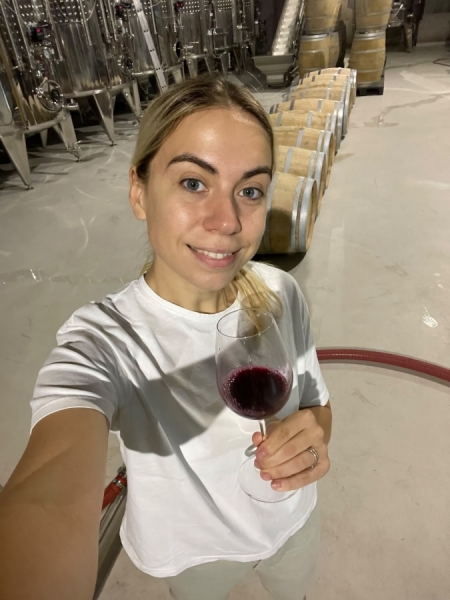
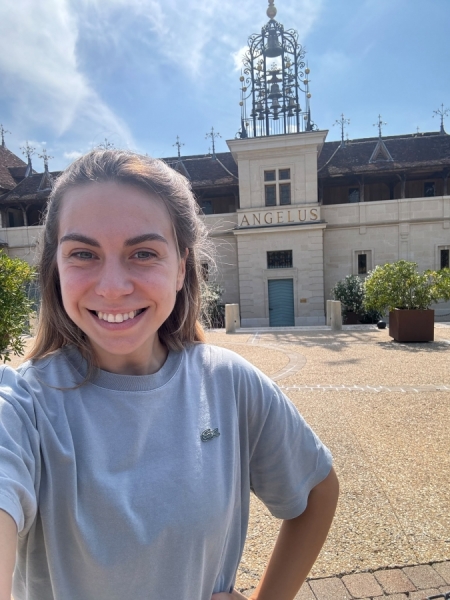
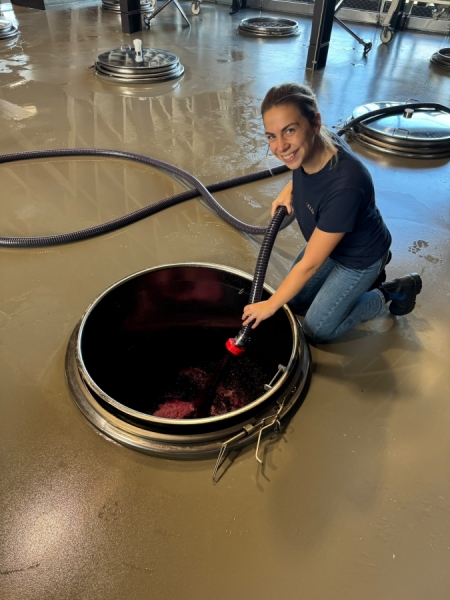
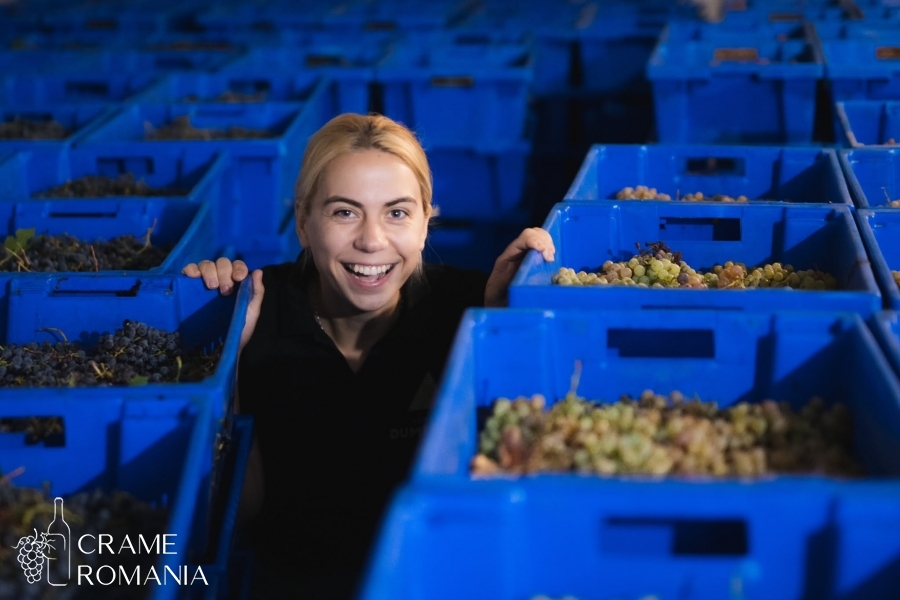
Aurelia Badiur is one of the winemakers who has built her professional journey between two different, yet equally fascinating wine worlds: Romania and France. With academic training in Reims, Burgundy, and Bordeaux, and experience gained at renowned estates such as Château Montrose and Château Angélus, she approaches wine through a combination of technical rigor, curiosity, and deep respect for terroir.
Today, Aurelia works as an independent consulting oenologist, collaborating with producers who seek to fully express their identity and potential. She firmly believes that there are no universal recipes in winemaking and that each region must be understood and approached according to its own unique characteristics.
We spoke with Aurelia about the differences between Romania and France, the challenges facing the wine industry, the relationship younger generations have with wine, and the steps Romanian wine must take to become more visible on the international stage.
You have studied and worked in both Romania and France, including in prestigious wine regions and estates. How have these different experiences influenced your philosophy and approach to winemaking?
My experiences in such diverse regions taught me, above all, to unlearn absolute protocols. In oenology, there are no universal recipes; every project, every region, and every terroir is unique, and what works perfectly in one place will never be replicated exactly somewhere else.
My philosophy is built on constant curiosity and a culture of questioning: “Why are we doing this and not something else?” Every action in the vineyard or winery must be studied, analyzed, and adapted using current solutions rather than applied mechanically. Moreover, I have learned that prevention is the true key to success. Instead of correcting mistakes, we anticipate risks through discipline and respect for the grapes, guiding the wine toward the purest expression of its origin.
What are the main differences you have observed between the wine industries of Romania and France, both in terms of production and the mindset of producers and consumers?
The main difference lies in the depth of the roots and the dynamics of evolution. In regions such as Burgundy and Bordeaux, we are talking about an ancient culture where savoir-faire is passed down organically from generation to generation. What is truly fascinating, however, is that despite this extremely solid historical foundation, producers never become complacent. They continuously research, adapt, and evolve in pursuit of perfection, fully aware that there is always room for improvement. Tradition does not hold them back; it drives them forward.
In Romania, in my view, we are still building this solid foundation of savoir-faire. We have imported modern technologies and techniques from abroad, which was a necessary step, but we have now reached the stage where we must move beyond simple imitation. Our current challenge is to define the uniqueness of each region and learn how to adapt techniques to our own needs, our regional characteristics, and the nature of our indigenous grape varieties. We need to move from “how it is done elsewhere” to “what works best here.”
How would you describe your winemaking style? What elements do you consider essential in creating a wine that authentically expresses its terroir?
My winemaking style is, paradoxically, both very simple and extremely complex. I have invested, and continue to invest, a great deal of time in mastering the full spectrum of technical and scientific possibilities so that I can select and adapt the most appropriate solution depending on the context or challenge.
My theory is that a wine’s style is born in the vineyard and in the place it comes from. We must select vineyard parcels and harvest timing with such precision that intervention in the winery can remain minimal. Whether we aim to produce a varietal wine, a fresh and approachable wine, or a gastronomic wine, the approach begins differently in the vineyard, and the winemaking techniques that follow will also be entirely different.
At the same time, I am someone who prefers to make decisions throughout the process by tasting and monitoring the wine’s evolution at every stage. I will never provide a fixed recipe because it simply will not work.
A concrete example is my passion for color and phenolic extraction in red wines, an area where fixed protocols fail miserably. I learned this craft in Saint-Estèphe, a region with considerable phenolic potential, specifically at Château Montrose. There, I understood that the secret of perfect extraction, enough, but never excessive, lies in decisions that are analytical in nature but guided primarily by tasting. By evaluating the wine day after day, you adapt extraction techniques in real time rather than following a manual.
Wine consumption is undergoing significant changes globally. How do you see the market evolving over the next five years, and what are the biggest challenges for producers?
The global wine sector is undoubtedly going through a period of profound transformation. Beyond the obvious effects of climate change, which are already forcing us to modify vineyard and winery practices and implement new solutions, we are also facing a visible decline in wine consumption worldwide.
However, I see these challenges as a catalyst that will ultimately change the industry for the better. Over the next five years, only those who can adapt quickly will survive and thrive, but entirely new ways of attracting consumers will also emerge.
I believe a significant part of the current crisis stems from the fact that, for decades, the real needs of consumers were often ignored. The industry frequently offered what it wanted to produce rather than what the market was asking for. Today, we see successful business models precisely because they had the courage to adapt and listen to consumers.
A telling example is the success of New World wine-producing countries. They understood that the Old World often offered excellent wines but wrapped them in a philosophy that was too difficult for many consumers to understand. The newcomers broke the mold by offering highly fruity, clean, approachable wines, and, most importantly, labels that clearly explain what is inside the bottle. Younger consumers are no longer interested in memorizing rigid classifications or obscure regions; they are guided by simplicity of choice and immediate pleasure, and producers must provide exactly that kind of effortless experience.
What do you think the wine industry needs to do to remain relevant and attractive to Millennials and Gen Z consumers?
To remain relevant in the eyes of Millennials and Gen Z, the wine industry must first and foremost let go of its tendency toward rigidity, pretentiousness, and elitism, traits that often intimidate rather than attract consumers. Today, we are witnessing a massive shift among younger generations toward other beverage categories, such as cocktails, cider, and craft beer, for one simple reason: these products are easy to understand, communicated in a relaxed way, and associated with a dynamic lifestyle rather than an academic exercise in cultural knowledge.
If wine remains trapped in a rigid discourse, it risks losing touch with this new audience entirely. Young consumers want communication that is direct, visual, and integrated into their digital world.
A powerful example is the rise of wine e-commerce in China through Douyin, the Chinese version of TikTok. There, wine is no longer sold through lengthy technical sheets but through highly dynamic live-streaming sessions. One famous case involved NBA star James Harden, who sold 10,000 bottles of his wine brand in just five seconds during a Douyin livestream alongside a top local influencer. Young consumers buy wine there because it is presented as entertainment and instant social engagement, without language barriers or unnecessary complexity.

You mentioned your interest in collaborating with Romanian wineries. What would motivate you to get involved in a project in Romania, and what types of wineries or wine regions appeal to you the most?
Both in life and in my profession, I have a constant need for challenges and a natural curiosity that pushes me to keep exploring. For this reason, what truly attracts me in Romania are not straightforward projects, but wineries that seek something more than simply producing a wine. I am interested in partners who want to build a long-term vision and a strong stylistic identity.
For me, however, the ideal collaboration is based on a genuine exchange of ideas and philosophies. I join a project to complement the existing team, not to replace something that already works or impose an elitist concept disconnected from reality.
An openness to new ideas is essential. I am not the kind of consultant who sends rigid protocols from afar. My vision involves active support and physical presence, with full commitment to the process. I want us to be partners in dialogue, constantly questioning our decisions in order to evolve, preserving what works while creating real value tailored to each individual terroir.
If you had to choose one Romanian grape variety and one international variety that best represent your tastes and vision of wine, which would they be and why?
If I had to choose one Romanian variety, it would undoubtedly be Negru de Drăgășani. I am simply fascinated whenever I work with it. I believe it has tremendous potential and deserves much more exploration in Romania.
It possesses excellent phenolic structure, allowing winemakers to experiment with extraction techniques and find the perfect balance in the cellar. Its aromatic profile is remarkably complex, ranging from fresh black fruits to spicy notes, while its natural freshness makes it especially intriguing. It is one of our native varieties that truly deserves international recognition.
Among international varieties, I have completely fallen in love with Pinot Noir. It is a difficult, demanding, and often misunderstood grape. I was fortunate enough, during my time as a consulting oenologist in Burgundy, to follow it closely alongside an outstanding team of specialists, across different soil types and vineyard sites, while also observing examples from outside France.
This experience taught me that Pinot Noir is, above all, a grape of terroir rather than of the winemaker. As a winemaker, you should not impose your will or force techniques upon it. Your role is to care for it, prevent problems, and help shape its qualities while allowing the terroir to speak through the glass.
Together with my colleagues in Burgundy, I witnessed the many faces of Pinot Noir, from light, fruit-driven wines to some of the most profound, complex, and age-worthy wines in the world.
How do you assess the quality level of Romanian wines today, and what do you consider to be Romania’s main strengths on the international wine scene?
In recent years, Romanian wines have shown remarkable qualitative progress. There is already a clear movement toward promoting indigenous grape varieties and embracing modern wine styles that are much better aligned with consumer preferences. However, I believe the next step must be a bolder and more original focus on regional identity and distinctiveness.
To stand out internationally, we need to understand a simple reality: the global wine market is already saturated with generic, technically correct wines made from the same widely planted grape varieties found everywhere. Consumers are no longer looking only for technically sound wines; they are eager to discover originality, authenticity, and the unique character of different countries and regions.
International consumers will not choose a generic Romanian wine simply because it is competitively priced—they already have countless alternatives. They want to understand why that wine comes from Romania and what makes it unique.
For a long time, we followed a copy-and-paste model based on international styles. But it makes little sense to compete with the world’s most established wine regions on their own terms, because we will never do it better than they do. Our opportunity lies in being unique, embracing our identity and our terroirs. Only then will we secure a lasting place on the global wine market and become truly relevant.
What should the Romanian wine industry do to become more visible and appreciated internationally? Is it mainly about marketing, education, identity, or something else?
It is a combination of identity and consistency. Romania has good wines and an extraordinary diversity of indigenous grape varieties, but internationally we still lack a clearly defined identity. We cannot compete in export markets solely through price or by imitating international styles.
I believe the first step is to clearly define our strengths and promote them collectively as a country, rather than as isolated brands. Marketing is essential, but it must support a strong identity: showcasing what makes us unique, our grape varieties, our terroirs, and our ability to maintain consistent quality from one vintage to the next.
Education is equally important, both within Romania, where it can help raise consumer expectations and appreciation for quality, and abroad, where we need to communicate the story, heritage, and uniqueness of Romanian wine to international buyers and consumers.
Looking 20 years ahead, how do you think the wine world will evolve? What trends will define the future, and what role could Romania play in that evolution?
Twenty years from now, the wine world will be profoundly shaped by climate change and technological innovation. We will see major adaptations in viticulture, including the relocation of vineyards to higher-altitude or cooler areas, more careful water management, and a natural transition toward increasingly sustainable and environmentally responsible practices, as consumers will demand greater transparency than ever before.
At the same time, consumption trends are already changing. Consumers are increasingly seeking fresher, more balanced wines with more moderate alcohol levels.
Romania has tremendous potential to thrive in this future if it can anticipate these changes. We still have wine regions with favorable climatic conditions, as well as a level of flexibility that many Western European regions, constrained by stricter regulations, do not enjoy.
If we invest today in research, modern winery technology, and the protection of natural resources, Romania can become a highly competitive player and a model of adaptation on the global wine map.
Alina Iancu
09/06/2026